Bluebonnet is here.
Whether you love it, hate it, or are still trying to figure out what tab you left the Teacher Edition open in, your personal opinion probably is not the thing driving your lesson plans.
Districts are making hard budget decisions. Texas has made Bluebonnet Learning available as a state-developed instructional resource, and many teachers are now expected to implement it. TEA describes Bluebonnet as covering the TEKS and providing teachers with daily lesson plans, student materials, differentiation supports, and other instructional resources. Texas Education Agency
So for me, the question is not:
“Do I like Bluebonnet?”
The better question is:
“How do I make this work for the students who are actually sitting in front of me?”
That starts with understanding what the lesson is really asking students to know and do.
I am not reading every script word-for-word. I am not creating a completely different curriculum either.
I keep the objective, understand the skill, and then make instructional decisions based on my students, my classroom, my available materials, and the time I actually have.
Bluebonnet itself includes differentiation guidance throughout the kindergarten materials. The RLA materials, for example, include Support and Challenge sidebars as well as specific guidance for Emergent Bilingual students. Texas Education Agency
That flexibility matters because a lesson that looks perfectly reasonable on paper does not always look reasonable with a room full of five-year-olds.
Here are five ways I make it work.

1. I keep the objective and adjust almost everything else as needed
The objective is my anchor.
Before I start changing anything, I need to know:
- What skill are students supposed to learn?
- What concept should they understand?
- What should they be able to do by the end?
- What does mastery actually look like in the TEKS?
Once I know that, I have much more freedom in how we get there.
I may condense the lesson.
I may change the materials.
I may add movement.
I may move part of the lesson into small group.
I may add another example before students work independently.
But the skill stays intact.
This is also why internalization matters so much.
When I plan, I do not start by asking, “How am I going to get through all of these pages?”
I start by asking:
What is this lesson actually trying to teach?
I will look at the lesson, review the standard, and often check the TEKS guide to see what mastery of that standard really requires.
Then I can decide what my students need.
This is also one place where I use tools like ChatGPT or NotebookLM. I may ask for a plain-language explanation of the unit or module, the central skill, or the progression of learning before I start planning individual lessons.
The point is not to have AI teach the lesson for me.
The point is to understand the instructional destination before I start rearranging the route.
2. I reduce teacher talk and increase student thinking
This is probably one of the most consistent changes I make.
If a lesson requires me to talk for a long stretch, I am probably going to shorten it.
Kindergarten students need opportunities to:
- talk
- move
- manipulate materials
- explain their thinking
- practice
- make mistakes
- try again
They do not need to listen to me deliver a 20-minute monologue about mathematics.
And I am someone who can talk.
So this is me holding myself accountable too.
Math fluency is a good example.
I frequently adjust the fluency portion.
The goal is still fluency, but I also use that time to develop mathematical thinking.
Instead of students simply giving me an answer, I may ask:
How do you know?
Can you show me another way?
Who solved it differently?
Do you agree? Why?
What changed?
Even in kindergarten, students can begin explaining and justifying their thinking.
That moves them beyond:
“Two plus two is four because I memorized it.”
and toward actually understanding what the numbers represent.
The same principle applies to reading.
Some of the kindergarten Knowledge read-alouds are long and language-heavy. I will often shorten the amount I read at one time, add visual support, stop for purposeful discussion, and use gestures or movement.
I would rather students understand and interact with a smaller chunk than sit quietly while I successfully “cover” six pages they stopped processing three pages ago.
3. I build movement and transitions into the lesson — when my class can handle it
Five-year-olds need movement.
But movement without classroom management is just relocation.
There is a difference.
A math lesson in my room might look something like:
Carpet: quick fluency/math talk
↓
Seats: application problem
↓
Movement or hands-on space: concept development
↓
Carpet: guided whole-group practice
↓
Seats: independent problem set
↓
Carpet: debrief
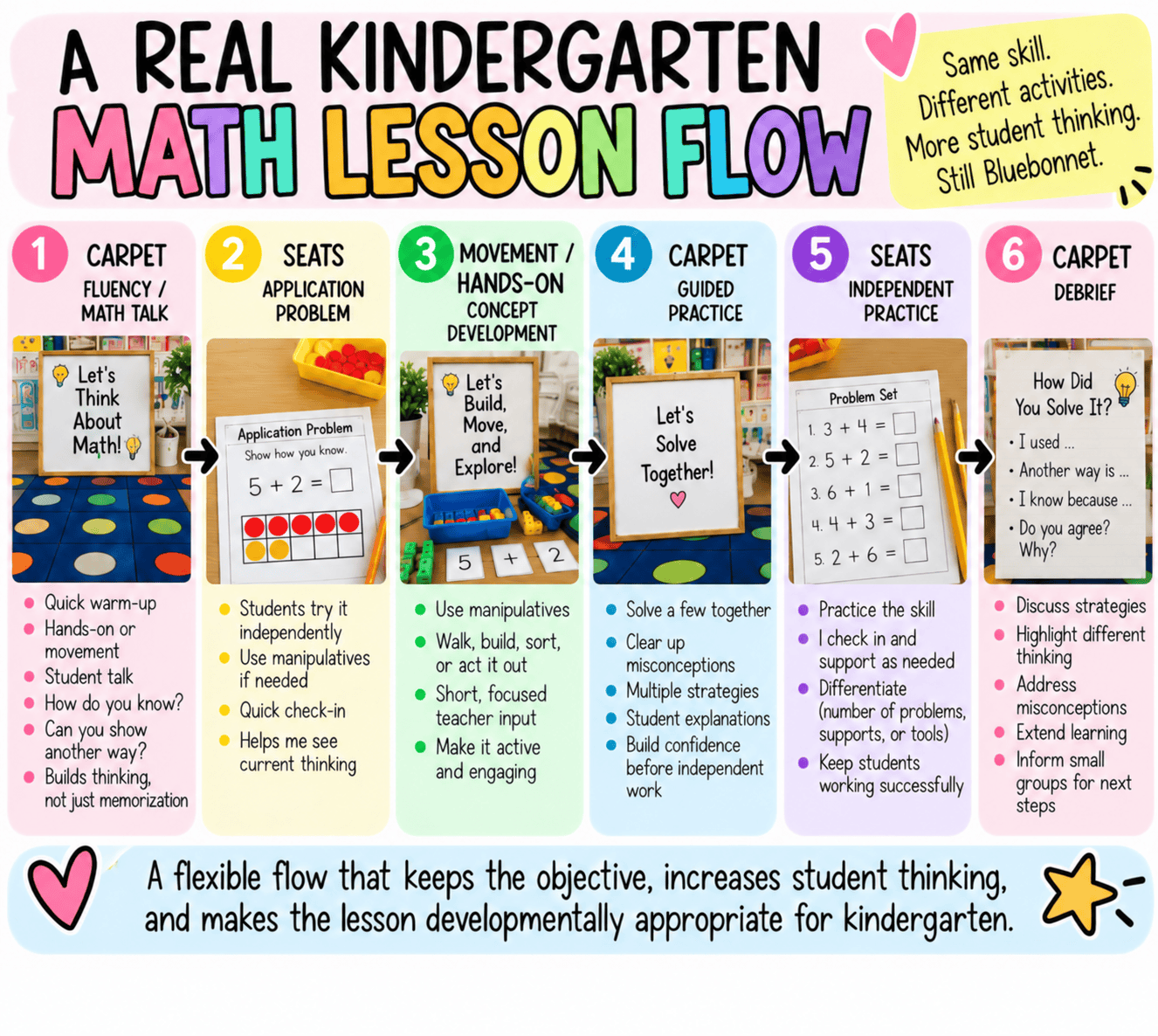
That sounds like a lot of transitions because it is.
It only works if students know how to transition.
If moving from the carpet to tables takes seven minutes and three reminders about why we cannot crawl under the tables, I have just destroyed the lesson.
So I adjust this based on the class.
Movement is a tool.
It is not a requirement.
Sometimes developmentally appropriate instruction means moving around.
Sometimes it means recognizing that today’s class is not ready for six transitions and keeping everyone where they are.
You have to know your students.
4. I chunk the work before asking students to do it independently
I do not like sending kindergarten students to independent practice completely cold.
If the problem set contains a particular question format, we practice something similar together first.
Not the exact question.
A similar one.
That gives me one last opportunity to catch misconceptions before students sit down independently.
For example, if they are about to complete five math problems involving a new concept, we may solve one or two comparable examples together.
I can model the thinking.
Students can explain what they notice.
Someone can make a mistake and we can fix it together.
Then I release them.
That independence looks different depending on the student.
My higher students
Generally receive very little support.
I check the work, provide immediate feedback, and extend their thinking when appropriate.
My students who are mostly on level
Usually need a quick check-in.
I may correct a small misunderstanding or ask them to explain something to make sure they really understand it.
My students who are struggling
Get significantly more prompting and teacher support.
Sometimes I also reduce the number of problems.
If there are five questions and question five demonstrates the actual depth of the concept, a struggling student may work through fewer questions with me rather than unsuccessfully racing through all five.
That does not mean changing the learning objective.
It means changing the support required to reach it.
And Bluebonnet’s kindergarten materials specifically include scaffolds, differentiated supports, and extensions for students at different proficiency levels. Texas Education Agency

5. I use stations and small groups to give students the practice the core lesson cannot provide
Whole-group instruction cannot do everything.
That is where my learning stations and small groups become important.
Monday through Thursday, my students work in learning stations rather than play-based centers.
I generally have four:
- two foundational-skills stations
- one fine-motor station
- one math station
The entire station block is roughly 20 minutes.
That includes approximately:
- 1 minute to preview expectations/materials
- 15 minutes of work
- about 2 minutes to clean
- a very quick debrief
There are usually about four students at each station.
Most importantly, the stations connect directly to what we are currently learning.
If we are learning the letter H, students might first complete handwriting practice focused on correctly forming H.
When that required practice is finished, they might move into a more hands-on alphabet matching activity.
The fun activity is not the lesson.
It is additional practice.
That distinction keeps me from spending Sunday afternoon creating a Pinterest-worthy center involving seventeen laminated pieces and a tiny basket from Target.
The point is practice.
Small groups are where I go deeper
Bluebonnet does include extra-practice activities and extensions, and I absolutely use those when they fit what students need.
But small group is also where I fill gaps.
Early in foundational skills, for example, I want students getting additional opportunities with:
- phonological awareness
- decoding
- encoding
- blending
- letter-sound fluency
- vocabulary
I consistently use Heggerty for phonological awareness.
When introducing a letter, I may use parts of the Bluebonnet foundational-skills lesson, then add other practice.
Let’s use H as an example.
We might:
- Introduce H and its sound.
- Practice producing the sound correctly.
- Complete one of the lesson activities.
- Listen to a song.
- Generate words beginning with H.
- Complete word chaining.
- Practice forming H.
- Write a simple decodable sentence such as “H is for hot dog.”
- Read the sentence back.
- Illustrate and label the picture.
Now I have built several layers of practice around the same skill.
And differentiation happens naturally.
A student who needs more support may focus primarily on correctly writing and reading the sentence.
A more advanced student may add details, additional labels, or another sentence.
Same objective.
Different level of independence and extension.
One thing I refuse to do: overprep everything
I do not laminate everything anymore.
I do not believe every learning station needs to look like something photographed for Pinterest.
And I do not want to spend two hours preparing an activity students will use for fifteen minutes when a piece of paper and a pencil would accomplish the same objective.
There is absolutely a place for:
- manipulatives
- games
- colorful materials
- reusable resources
- hands-on learning
But I ask myself:
Is this extra preparation improving the learning, or just improving the picture?
If the answer is the picture, I usually skip it.
Because the real luxury in teaching is not having beautifully laminated cards.
It is having time.
Do not skip the debrief
If there is one Bluebonnet component I would tell teachers not to rush through, it is the debrief.
The debrief tells me what happened inside students’ heads.
That information determines what I do next.
I can identify:
- misconceptions
- students who need reteaching
- students who are ready for extension
- vocabulary issues
- strategies students are already using successfully
That information becomes tomorrow’s whole-group adjustment or today’s small-group plan.
Independent work tells me what a student wrote.
The debrief helps tell me why.
That’s much more useful.
So, do you have to teach Bluebonnet exactly as written?
I would frame that question differently.
You need to know what your district expects.
You need to preserve the intended grade-level learning.
And you need to understand the lesson well enough to make informed instructional decisions rather than randomly removing pieces because you do not like them.
But differentiation is not somehow outside the curriculum.
Bluebonnet’s kindergarten instructional materials explicitly contain differentiated instruction, scaffolds, vocabulary supports, enrichment, extensions, and guidance for students who have not yet reached proficiency. Texas Education Agency
Your job is not to perform the Teacher Edition.
Your job is to teach the students in front of you.
For me, that means:
Keep the objective.
Know the standard.
Reduce unnecessary teacher talk.
Increase student thinking.
Add movement where it helps.
Chunk the learning.
Differentiate the support.
Use stations and small groups intentionally.
Debrief.
And please stop laminating things just because you own a laminator.
Want the planning process I use?
I’m creating a free Bluebonnet Internalization Sheet with separate planning tools for:
- Math
- Reading/Knowledge
- Foundational Skills
The goal is to help you quickly identify the objective, standard, likely misconceptions, differentiation needs, materials, student practice, and what actually deserves your limited planning time.
The free Bluebonnet Internalization Sheets are in development. Join the email list for future updates and new resources.
I also share new classroom ideas, resources, and things I am actually trying on Pinterest and Instagram.
No twenty-email sales sequence.
Just useful things when I have something worth sharing.